Your basket is currently empty!
A brief story of Matisse’s Chapel
Until quite recently, I didn’t know there was a chapel in France designed and decorated by Henri Matisse. But as soon as I found out, it jumped to the top of my “must-visit” list. So, on a very hot and sunny day in July, during my stay in Saint-Paul de Vence, I parked right in front of it. It stands on a quiet street just outside Vence, the kind of place you’d drive right past without even noticing. The Chapel of the Rosary, also known as the Matisse Chapel. As I stepped inside, I was curious, even eager, to finally discover this space that is sacred in two ways: sacred through art and sacred through God. It wasn’t until later, once I’d returned home, that I (re)immersed myself in its history.
As with many things in life, it all started with a chance encounter. But not the kind you might expect. Henri Matisse met Monique Bourgeois in September 1942. Having undergone major surgery, he was looking for a substitute night nurse to care for him for fifteen days. Monique responded to the ad, feeling a little intimidated. Then a young nursing student, she was looking for a job to support her family. She was 21 years old.
At first, they spoke very little. But the old painter’s room was filled with statues, paintings and drawings, which Monique examined closely. When Matisse asked her what she thought of them, she said she didn’t find them “very pretty.” He wasn’t offended. Quite the contrary. He appreciated her frankness. During those two weeks, she reads books for him, she watches him, they have long talks.
This is undoubtedly one of the reasons why, once her night watch duties were over, Monique found herself called upon again by the old man, much to her surprise. But this time, not as a nurse. As an artist. She thus became his model, posing for him in the afternoons between 1942 and 1943. The young woman, who despite her apparent reserve had a strong personality, did not hesitate to tell him that she did not really recognize herself in his paintings, or even that she was only moderately fond of them. But for Matisse, it was a different story altogether. He confided in her, “It was with you that I made my best drawings,” and the four paintings in which she appears bear witness to this: Monique (1942), L’Idole (1942), La robe verte (1943), and Tabac Royal (1943).
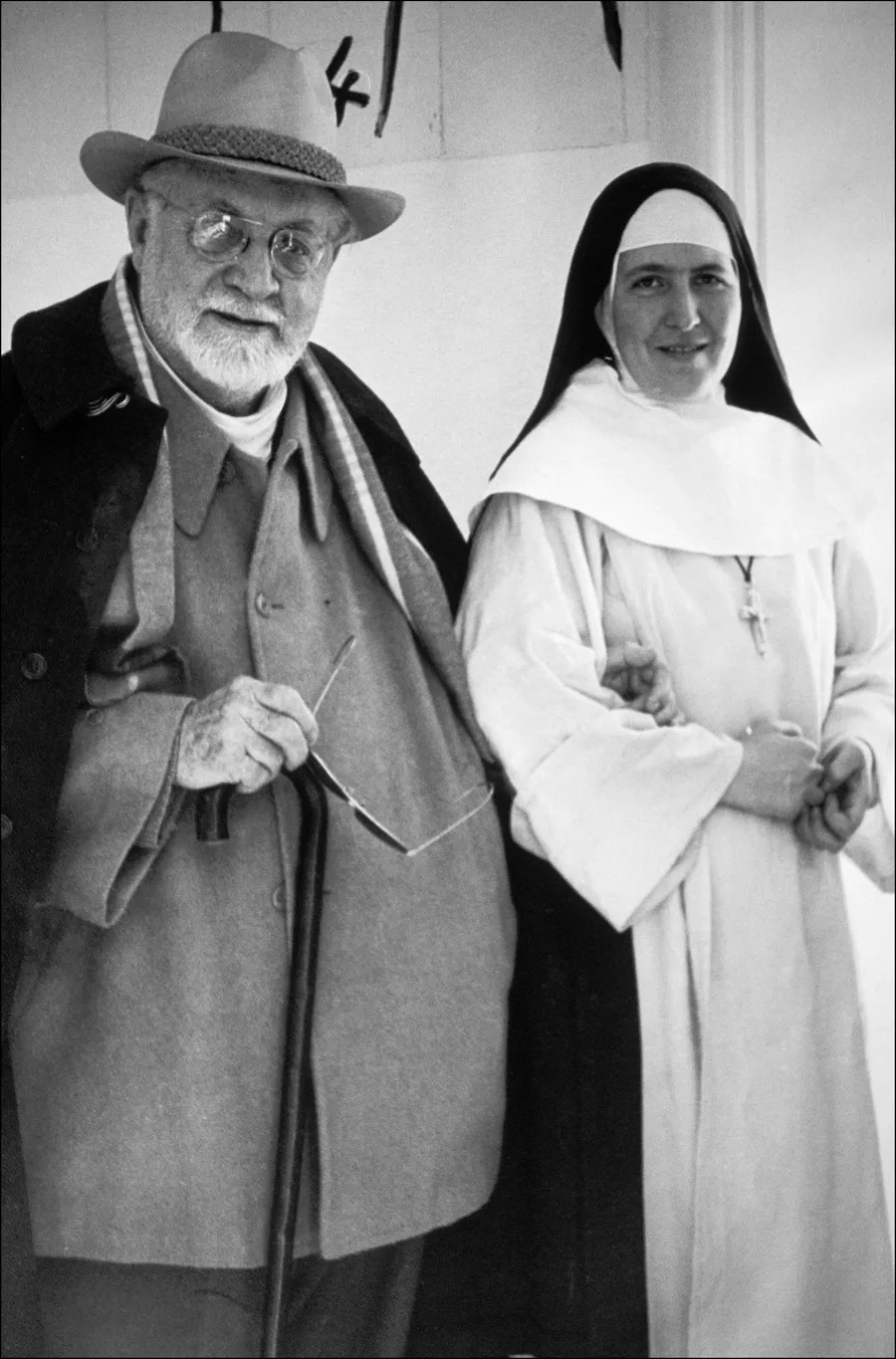
During these months of artistic collaboration, in which she also assisted him with his paper cutouts, their friendship took on an almost parental quality, nourished by frank, kind and profound conversations. She even went so far as to tell him that he was “like a grandfather to her.” Having never known her own grandparents, this was how she imagined them to be.
Their meetings came to an end when Matisse left Nice for Vence and moved into Villa Le Rêve, fearing air raids. After all, they were still in the midst of the war. Monique, for her part, was staying at the Dominican convent because of her fragile health. She felt there her religious calling grow stronger, until she could no longer ignore this deep urge: to enter religious life. She left for Aveyron in 1944 to join the Dominican Sisters and henceforth took the name Sister Jacques Marie. When Matisse learned of her decision, he was devastated, and their correspondence got suspended for a few months.
It wasn’t until 1946 that they were reunited, after the nun returned to Vence for health reasons. The affection that bound them had not faded. Matisse was genuinely moved to see her again, moved to see her wearing a religious habit. Their friendship was rekindled, each watching over the other in their own way.
At that time, the sisters did not have a proper place of worship in Vence, and Sister Jacques told Matisse of her wish to provide them with a chapel where they could meditate and pray. She even sketched a design for a stained glass window, which she showed to the painter. He was so enthusiastic about the project that he decided to give them a chapel and help finance it. With the support of Brother Rayssiguier, a lover of modern art, Father Marie-Alain Couturier, and the architect Auguste Perret, Matisse began work in early 1948 on what would become, in his own words, his masterpiece, the culmination of his entire career.
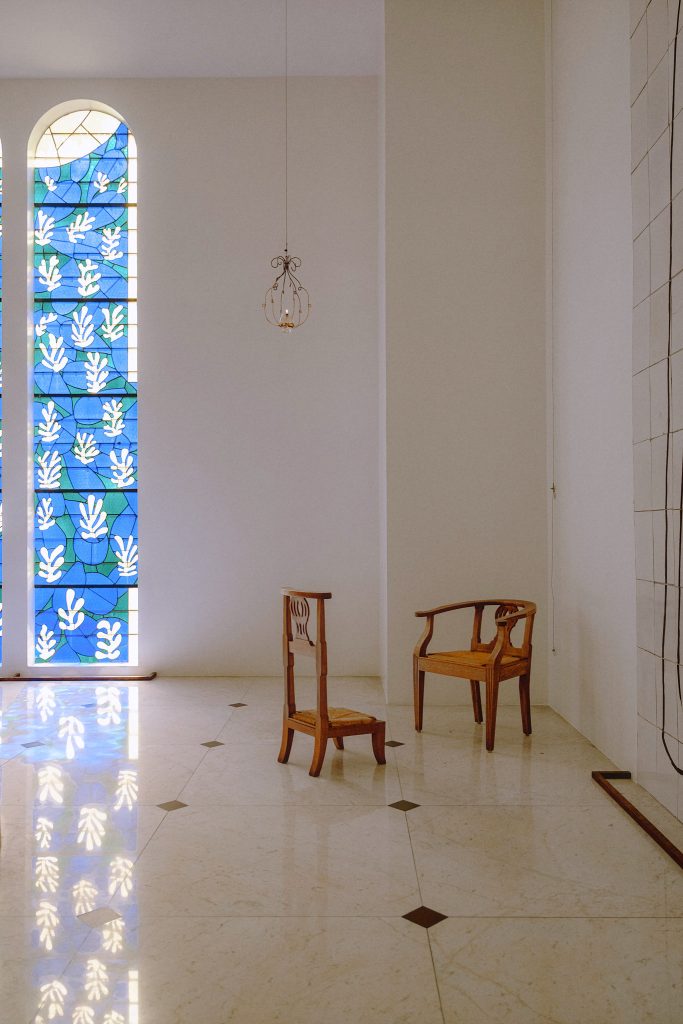
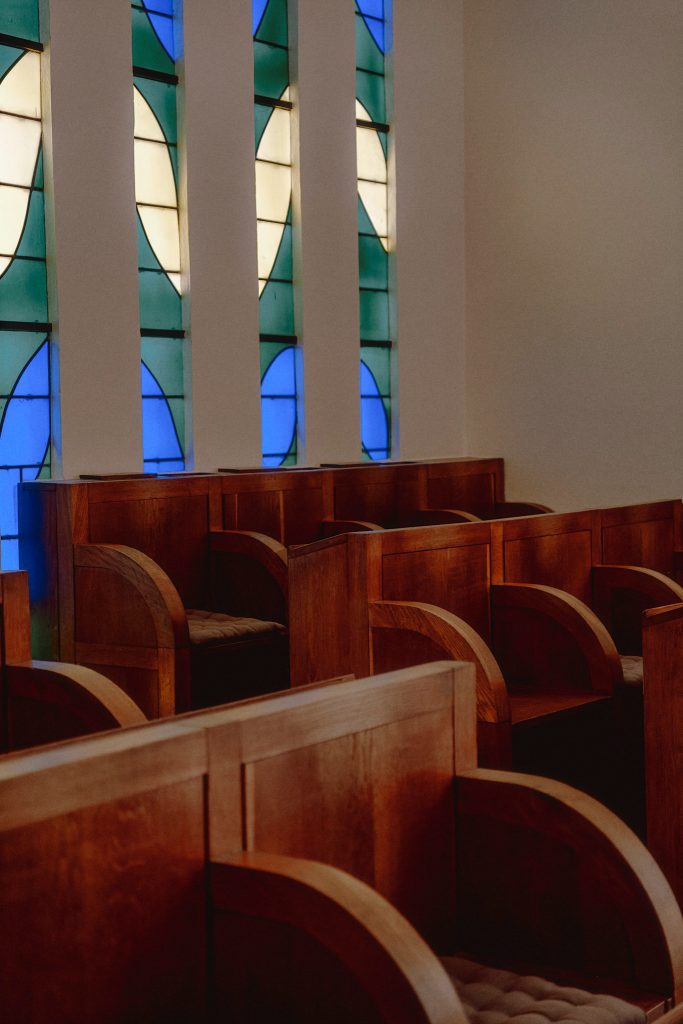
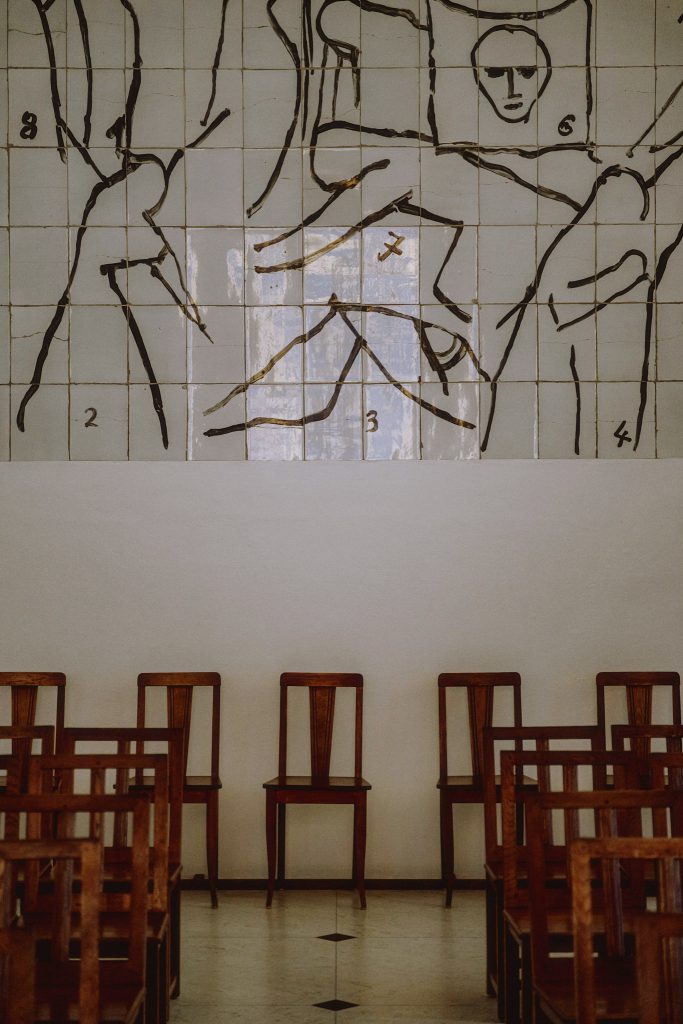
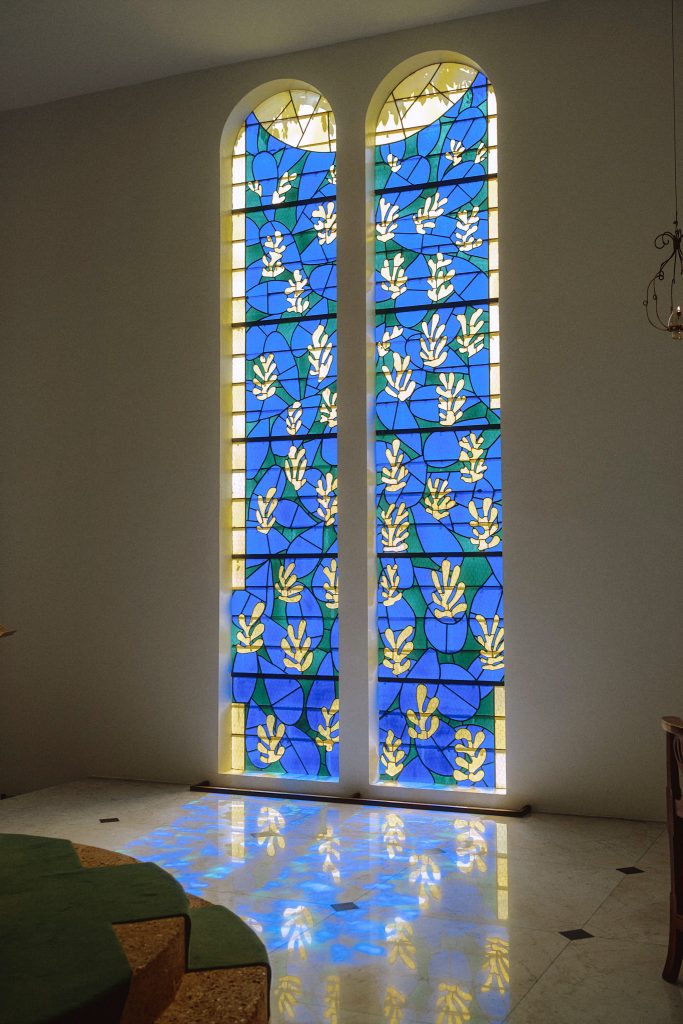
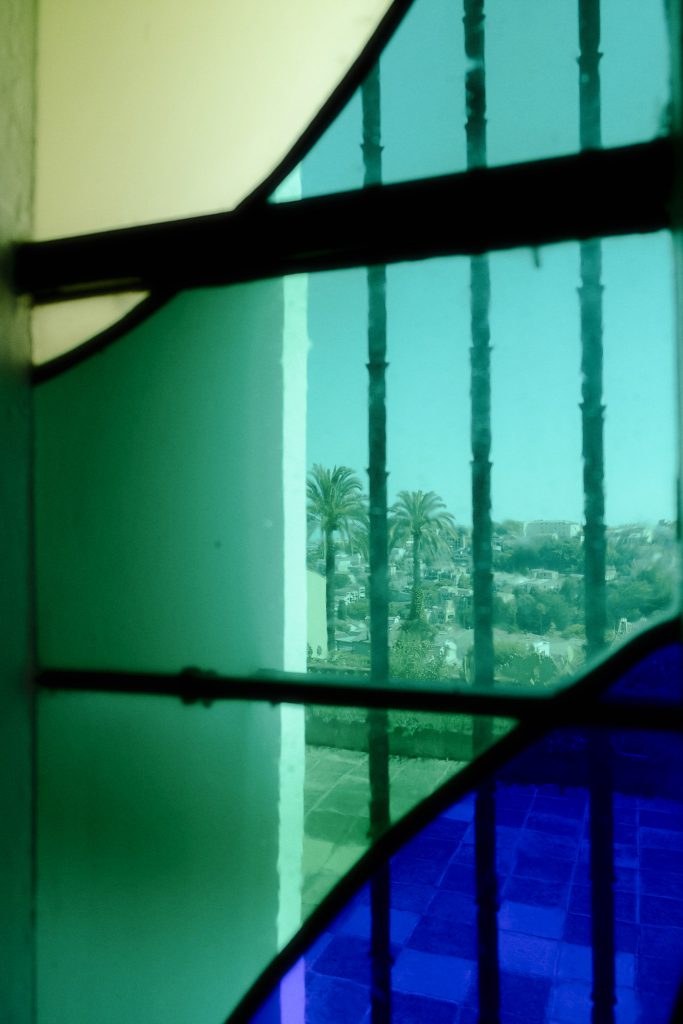
While each of them was deeply convinced of the merits and significance of their collaboration, the same could not be said for the rest of the world. Matisse envisioned a stripped-down, pure, and tranquil space, with floor-to-ceiling stained glass windows in vivid, precise hues: ultramarine blue, bottle green, lemon yellow. This modern and, for many, overly revolutionary approach was met with disapproval by the Church, which viewed his simplified sketches with suspicion, considering their simplicity a denial of Christ’s suffering. It was thanks to the repeated interventions of Sister Jacques, who acted as a behind-the-scenes mediator between the artist and the Dominican congregation, that the painter’s vision was gradually understood and accepted, allowing the project to move forward.
The controversies, however, were not confined to religious circles. The artistic avant-garde of the 1950s, deeply anticlerical, did not embrace this union of modern art and religion. Picasso in particular, known to be a close friend of Matisse, made no secret of his incomprehension, not to mention his disapproval, of such an undertaking.
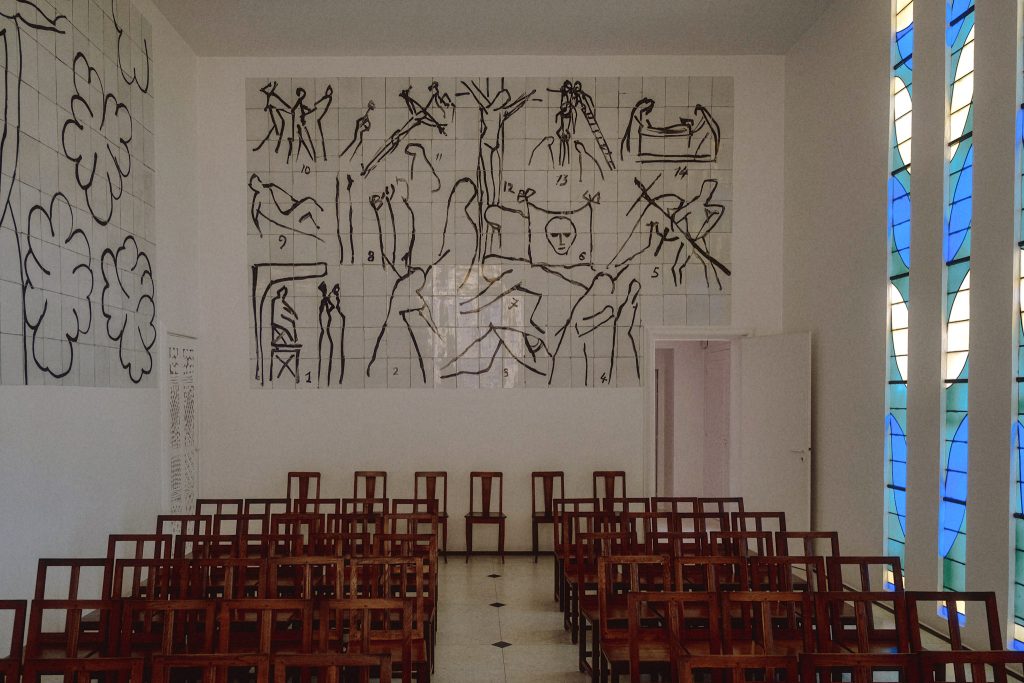
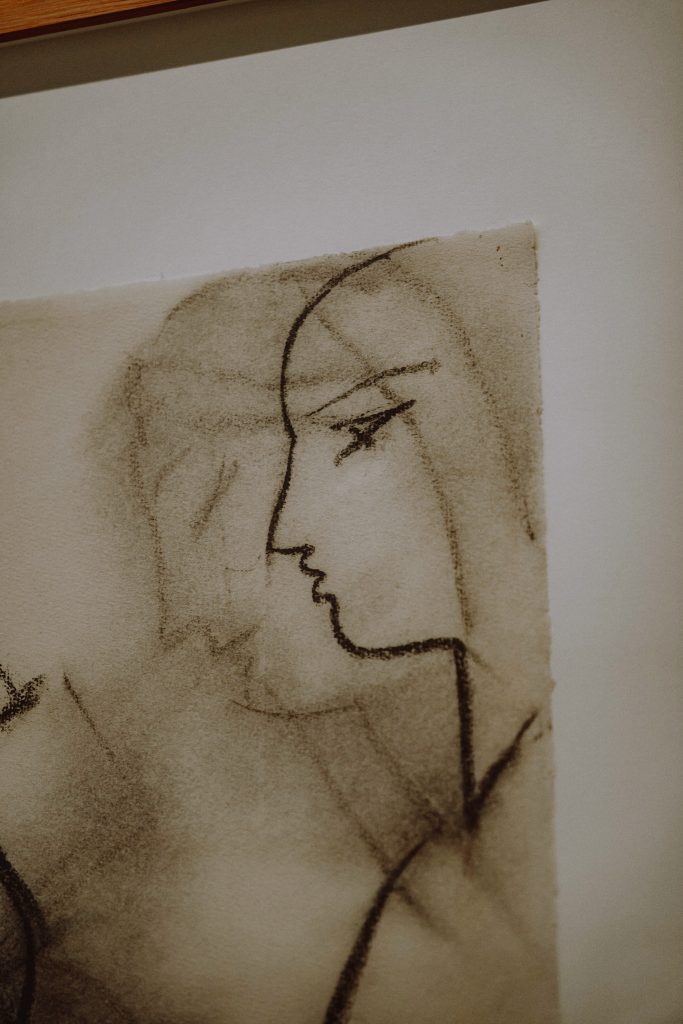
Yet nothing seemed capable of dampening the master’s determination to complete his work and bring his vision to life. He transformed his apartment into a studio, where the sketches for his frescoes and stained glass windows covered the walls at full scale. He drew hundreds of sketches of Saint Dominic, the Virgin and Child, and the Stations of the Cross, some of which are on display in the galleries adjacent to the chapel. That’s him, also, who designed the liturgical vestments, the tableware, the candlesticks, and the chasubles for the clergy. He conceived of the chapel as a unified work of art, where every element had to be coordinated, and where forms, textures, materials, and colors each carried a precise meaning, a raison d’être.
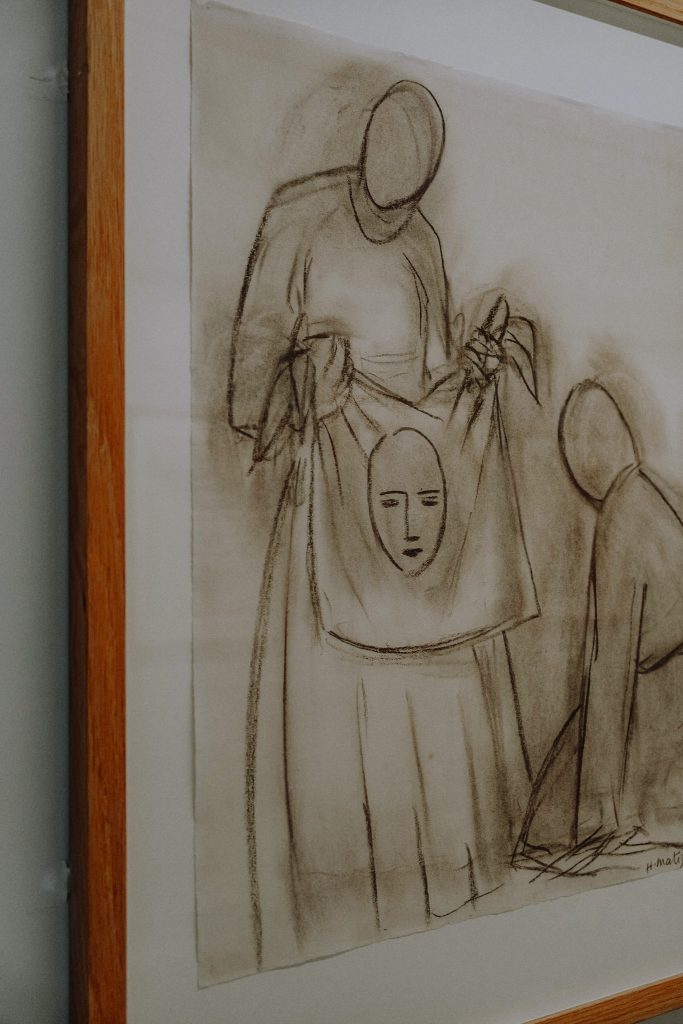
One must imagine him during the final months of construction, standing on a platform, eyes closed, his brush dipped in black enamel at the end of a fishing rod, drawing the frescoes, on which he had worked for so long, directly onto the ceramic tiles laid out on the floor. He wrote: “I must be so deeply immersed, so thoroughly imbued with my subject that I can draw it with my eyes closed. […] At a certain point, it is no longer me; it is a revelation: all I have to do is give myself over to it.”
The chapel was dedicated on June 25, 1951, after four years of research and painstaking work by the painter, who had by then become too frail to attend the ceremony. He died three years after the building’s completion, on November 3, 1954. “I began with the secular, and now, quite naturally, in the twilight of my life, I am concluding with the divine,” he wrote.
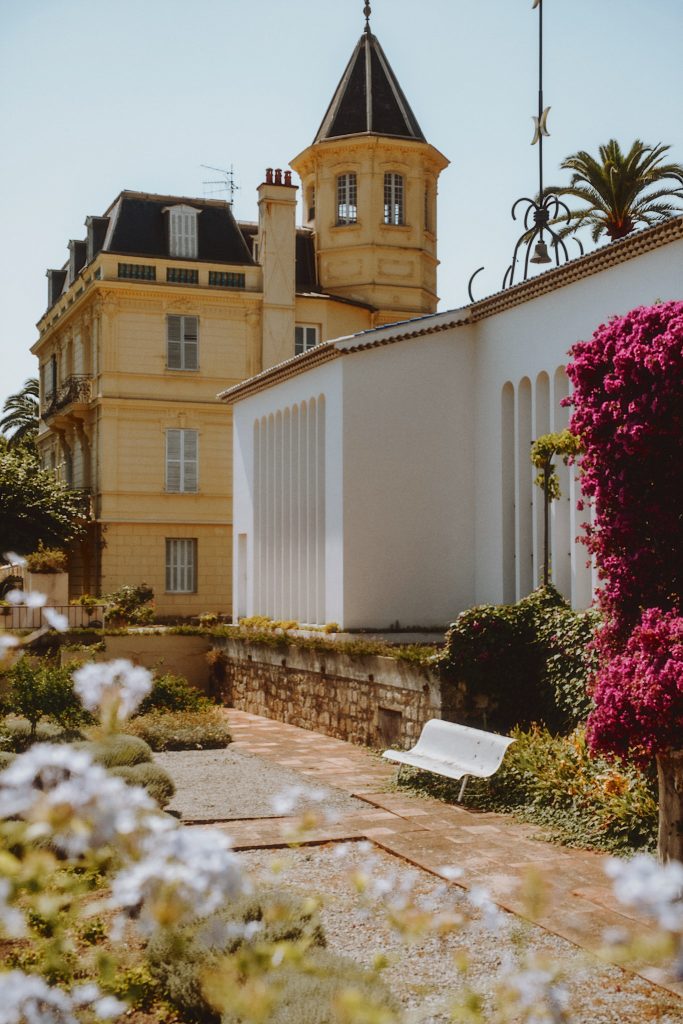
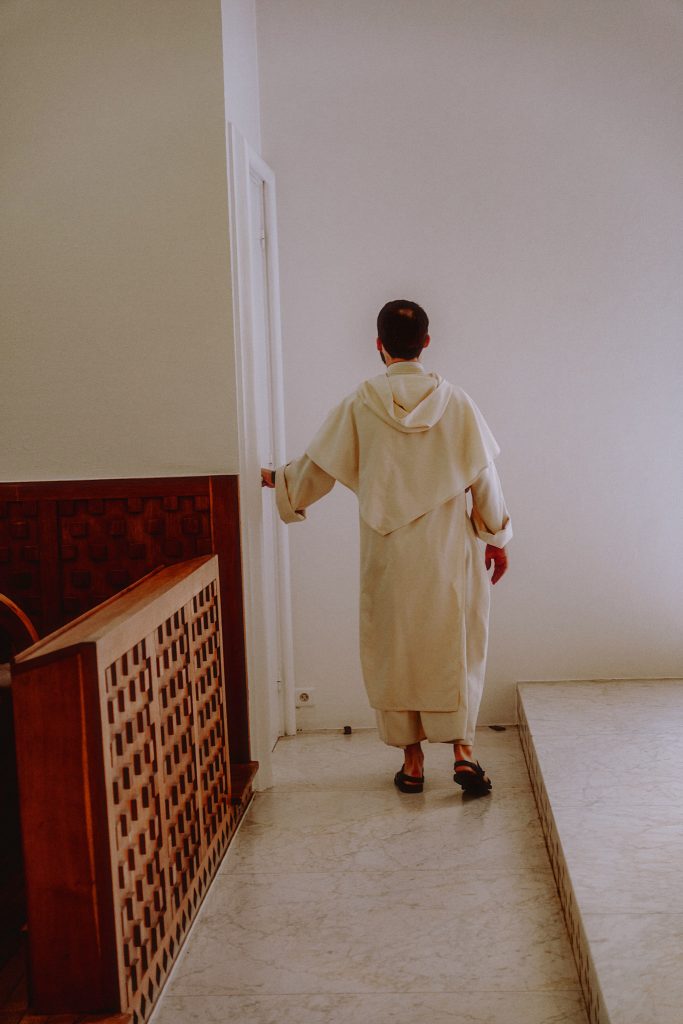
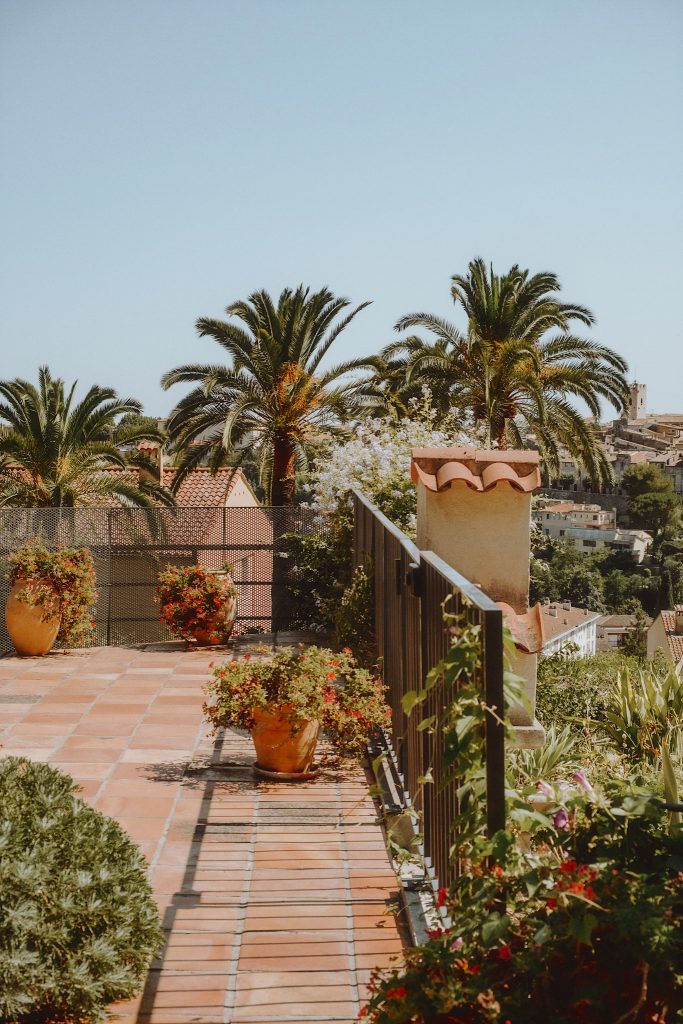
One can visit this place with an interest solely in its aesthetics. One may not be moved by Matisse’s interpretation of sacred art. But what seems self-evident today was, at the time, a true revolution. Matisse invented something that did not exist. He dared to do what had never been done, driven by a faith that was not religious, as one might assume, but deeply artistic and transcendent. In hindsight, I found this journey just as fascinating as it was moving. The same goes for the role of Sister Jacques Marie, a discreet yet remarkable figure, whom I discovered with great delight in the documentary (unfortunately no longer available) La chapelle du Rosaire, Matisse’s final masterpiece, directed by Joséphine Duteuil and broadcast on Arte.
” The immense crowd, heads as far as one could see, the architecture, the stained-glass windows and at times, the waves of the music of the organ passing over the heads were all most impressive. Upon leaving, I said to myself: very well! all of this considered, what is my chapel?… And then I thought: it is a flower. It is only a flower, but it is a flower.”
Henri Matisse, after his visit to Notre-Dame (Paris) in 1951
If you’d like to receive my monthly inspirational newsletter filled with poetry, exclusive photos, and small, sweet things, join the mailing list right here👇🏻

Leave a Reply