Your basket is currently empty!
A brief story of Montenvers
It is one of those winter mornings, when the sky is very high. Its pale blue stretches far and wide, its cold clarity seeming joyful as it edges the mountains with a sun-colored border. A small crowd gathers along the tracks, waiting for the train to arrive with gentle impatience. The cold rustles with conversation, the air filled with white breath.
The wagon arrives. It is bright red, as pure and deep as a smooth apple, gleaming like a miniature locomotive that has just been unpacked from its box. We take our seats against the window, on the polished wooden benches. There are no empty seats left, anoraks press against each other with that characteristic rubbing sound. The train starts moving.

It winds its way through the forest, still bathed in shadow and blue light. Its horn suddenly sounds, echoing down the slopes—if you listen carefully, you can hear it from Les Praz in the summer, that short, timeless song, as if coming straight from the belly of the mountain.
As we climb, snow settles in the undergrowth and the landscape changes: the valley becomes smaller, some slopes recede, others come closer, some peaks disappear and others become more distinct. Then, around a bend appear Les Drus, which seem immense, but also less inaccessible from here.
As the train passengers spill out onto the terraces and paths to admire the cirque of rock faces and bask in the sun, which is finally doing us the honor of its presence, we descend towards the Grand Hôtel du Montenvers. A humble but sturdy building made of light-colored stone, nestled obediently beside the railway track. It may seem a little austere, but that is part of its charm: it appears placid and immortal, opening its red and white shutters to the penetrating gaze of the peaks.

The Grand Hotel has stood here since 1880. But the history of Montenvers began long before that, in 1779. That year, an Englishman named Mr. Blair decided to provide this mountainous region with a small shelter so that brave visitors could protect themselves from the elements. But it quickly fell into disrepair. It was then that another great lover of the Chamonix Valley, Théodore Bourrit, from Geneva, took up the cause. He managed to find the financial support needed to build what would become the first real mountain refuge. Thus, in 1795, the Temple of Nature was born. Just below the Blair hospice, this small oval-shaped building dedicated to nature and the mountains became a must-see for all visitors to Montenvers. Its walls welcomed some of the most illustrious names of the 19th century: Victor Hugo, Lord Byron, Mary Shelley, Alexandre Dumas, Chateaubriand…
For several decades, it underwent deterioration and a few renovations, until 1840, when a new inn was built: the first hotel in Montenvers. At that time, the Temple of Nature was no longer a refuge, but a natural history museum, which travelers continued to visit for pleasure. The hotel operated for 40 years, until the construction of the Grand Hotel that we know today. With its arrival, the other buildings quickly lost their appeal and were even abandoned for good, although they are still visible on the slope to the left of the path.


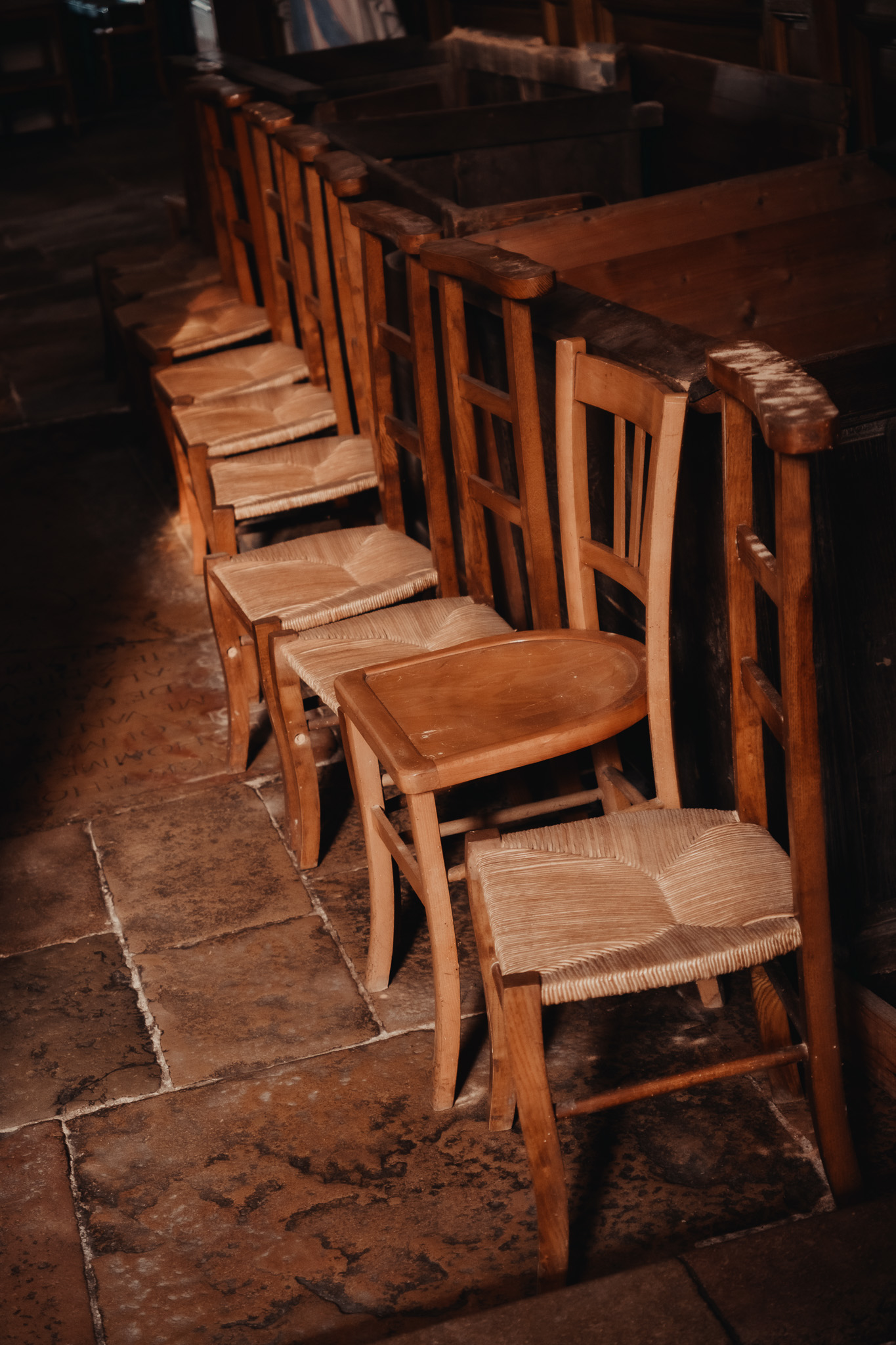
So, here we are. It stands before us. Its large terrace bathed in morning light is empty – at this time of year, tables and chairs are not brought out, as the minutes are counted before the return of the shadows. But still, we drink our coffee outside, cup in hand, nose toward the treetops. And when we step inside, it’s like entering a piece of history. Its panelled walls, its uneven parquet floor, its dark, red, welcoming atmosphere. We enter at the same time as the sun, which filters through the windows, just long enough for a happy appearance before disappearing beyond the peaks.
The great hall is still silent at this hour. I like it like that. It allows us to soak up the atmosphere of the place. We can feel the weight of a long century in the heavy air, in the creaking of the wood, in the smoked glass of the wall lights. We can hear boots pounding the floor, ice axe handles striking the parquet, metal water bottles clinking against the tables. The smell of snow and cold mingles with that of fire and wine. We can see woolen clothes hanging on coat racks and metal crampons drying on the porch. We imagine beards encrusted with ice and songs sung by the fireside, pain and camaraderie, tales of adventure and laughter that have filled the ceilings with memories.


In the back room, huge windows look out onto the opposite slope, giving us the curious impression of being outside of everything, suspended, privileged. Humbly familiar with the grandeur of nature and time. We have lunch there, behind the glass wall, watching the sun pass between the peaks. When it comes out, it bathes us in a gentle warmth and spreads its joyful glow throughout the room, the trees, and the slopes outside. The atmosphere is pleasant, the sound of footsteps on the parquet floor giving the impression of being in a large, old family house.
Hanging on the walls, you can see photos of Tairraz. Every Chamonix resident has seen photos taken by this illustrious family. A dynasty of guide-photographers from father to son, spanning four generations. Joseph, the great-grandfather, was one of the first, along with the Bisson brothers, to take a daguerreotype into the mountains and, in 1861, to take a photo from the summit of Mont Blanc. It is important to note that the camera alone weighed around 20 kilograms. Not to mention the tripod and glass plates, each weighing around 10 kilograms… A real expedition, and such a remarkable feat for the time!


It may has been this attachment to nature, its beauty, and experimentation that inspired the same vocation in his son Georges, then in his grandson Georges II, and finally in Pierre, the last guide-photographer to carry on the illustrious family tradition. Each in his own way contributed to magnifying the mountain, revealing its power and highlighting the depth of the bond that unites it with mankind, with great love and humility.
What remains of this love today? The mountain continues to exert an immense fascination, losing none of its mystique or indomitability. But it is not without danger. The Mer de Glace is a perfect and sad example of this. Once a glacier that flowed down the mountain like a wide, sparkling river, today nothing remains visible. Nothing but a moraine of grayish pebbles, that can only arouse a bitter sadness in those who contemplate it.
This is undoubtedly why seeing these photographs on these walls, at the edge of this glacier, takes on a special meaning, inviting us to reflect humbly on the passage of time. What we leave behind, as traces and as memories. We are both witnesses and actors in this time, in its evolution. To tread on ancient ground, to walk through ancient walls, is to momentarily inhabit a legacy. It is to confront the past and the present. And the gratitude we feel when observing what remains, as well as the sadness of seeing what has disappeared, must be our only compass, to honor, respect, and care for what was, what is, and what will be tomorrow, even when we are no longer here.


If you’d like to receive my monthly inspirational newsletter filled with poetry, exclusive photos, and small, sweet things, join the mailing list right here.👇🏻

Leave a Reply